 English
 français
 Deutsch
 italiano
 español
 português
 Nederlands
 Türkçe
 Tiếng việt
 Indonesia
 svenska
 norsk språk


Most buyers approve a custom umbrella on two numbers: unit price and lead time. Then the samples arrive, the logo looks sharp, everyone signs off — and three months later the edges of the print start to lift, the white base turns grey, or a dark logo on a navy panel has quietly disappeared into the fabric.
Almost every one of those failures traces back to one decision made early in the project: the printing method. It dictates how fine your artwork can be, how many colors you can afford, how the print feels in the hand, how it behaves when the umbrella is folded and crushed a few hundred times, and — depending on your order size — up to 20–30% of the unit cost.
This guide compares the four methods we actually run in production for bulk custom umbrella orders, so you can match the method to the job instead of defaulting to whichever one the factory quotes first.
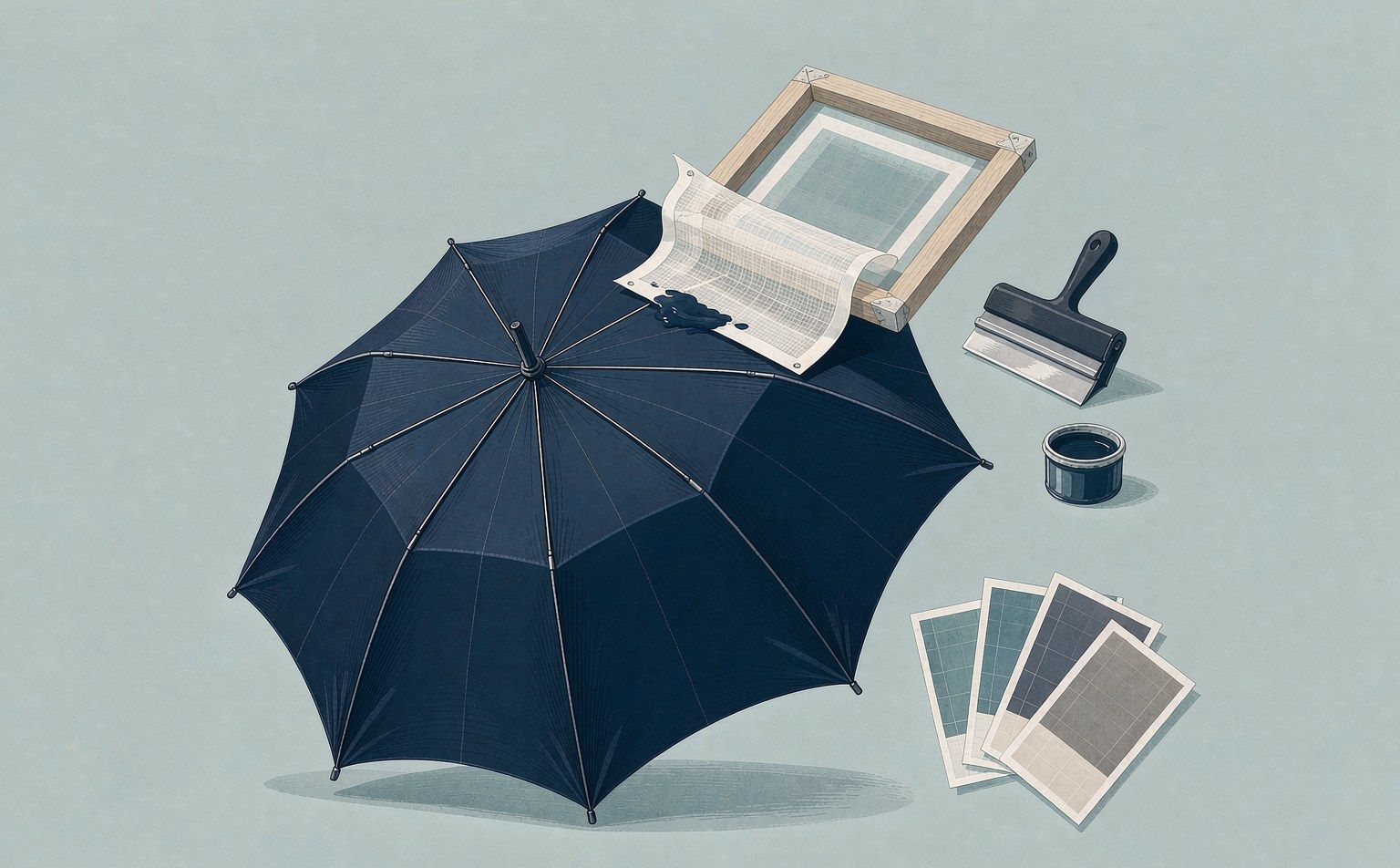
Four production methods, one decision: how the artwork gets onto the canopy.
A stencil is burned onto a mesh screen for each color, ink is pushed through, and the fabric is cured. One screen per color, per print position.
Best for: flat, solid-color logos and text — the majority of corporate, hotel and promotional programs. It is the workhorse method for a reason: crisp edges, strong opacity, and the lowest cost per unit once you are past a few hundred pieces.
Practical limits: gradients and photographic artwork are out. Very fine detail below roughly 1 mm will fill in. Printing light colors on dark fabric requires a white base layer, which adds a screen and a pass. Each extra color adds cost and setup.
Durability: excellent. Properly cured screen print on nylon or pongee outlasts the umbrella itself — two years of regular use is normal.
Your artwork is printed onto transfer paper, then pressed onto the panel with heat and pressure. It handles full color in a single pass, which makes it the practical answer for photographic logos, gradients and multi-color brand marks.
Best for: small and medium runs where the artwork has more than four colors, or where a photo-realistic image is essential. Also the standard route for short-run sampling.
Practical limits: there is a slight hand feel — a thin film you can sense with a fingertip. Poorly executed transfers lift at the edges after repeated folding, which is why the pressing temperature, dwell time and fabric coating matter more than the paper. If you are sourcing a folding umbrella that will be compressed thousands of times, ask specifically about edge adhesion testing.
Durability: good to very good with correct process control; noticeably weaker than screen print when the factory cuts corners.
The fabric is printed directly, without screens or transfer paper, using eco-solvent or UV-cured inks on a coated surface.
Best for: short runs, many SKUs, personalisation programs and designs that change frequently — for example event umbrellas where each city or sponsor gets a different panel.
Practical limits: cost per unit stays roughly flat instead of dropping with volume, so it rarely wins on large orders. Color vibrancy on very dark fabrics can be less punchy than screen print unless a primer is used.
Durability: good; UV-cured inks resist fading well, but abrasion resistance at fold creases is lower than screen print.
Artwork is printed onto paper, then heated to around 200°C in contact with the fabric. The ink turns to gas and bonds into the fibre itself, so there is no layer sitting on top of the fabric at all.
Best for: all-over patterns, edge-to-edge designs across multiple panels, and anything where the print must survive being folded flat. This is the method behind photographic umbrellas and full-panel branding.
Practical limits: it needs a polyester-based canopy — it will not work properly on cotton or on fabrics with certain coatings. Panel alignment across seams requires careful cutting and is where most quality problems show up.
Durability: excellent. The print is part of the fibre; it does not peel, crack or wash off.
| Method | Colors | Typical MOQ | Workable artwork | Hand feel | Relative unit cost |
|---|---|---|---|---|---|
| Screen print | 1–4 (more possible) | From ~50 pcs per position | Solid shapes, text | None to slight | Low at volume |
| Heat transfer | Full color | From ~24 pcs | Photos, gradients | Thin film | Medium |
| Digital direct | Full color | From ~24 pcs | Photos, variable data | None to slight | Medium, flat with volume |
| Dye sublimation | Unlimited | From ~100 pcs | All-over patterns | None | Medium to high |
Treat the MOQ column as an order-of-magnitude signal rather than a rule. Screen printing on a 24-piece trial order is possible but the setup cost dominates; the same logo at 1,000 pieces can drop to a small fraction of the unit price.
The method question is inseparable from the placement question, because each position has its own constraints:
The same logo can look dramatically different on 190T pongee, 210T high-density pongee and polyester. Tighter weaves hold finer detail and give a smoother print surface; looser weaves let ink wick slightly, softening edges. If your logo has fine type or thin strokes, the fabric specification is not a detail — it is half the outcome. Our fabric comparison guide covers density and coating in more depth.
Screen printing adds a screen-making step of roughly one to two days per color set, but once running it is fast. Heat transfer needs a proofing round because the pressed result can shift color slightly. Dye sublimation needs the longest artwork-to-press cycle, because panel layout and seam alignment are checked before production.
For a typical custom order, plan on samples in 3–7 days after artwork approval, and mass production in 15–30 days depending on quantity, print complexity and season. Peak season — roughly March to June in the northern hemisphere — adds pressure on every factory, so a project that needs June delivery should be locked in by February.
Can I mix methods in one order? Yes, and it is often the smartest option — screen print the logo on the panels and sublimation-print an all-over pattern on the carry sleeve, for instance.
What is the minimum order for a full-color logo? Around 24 pieces per color and style for heat transfer. Screen print becomes economical from roughly 100–200 pieces upward.
Will my Pantone color match exactly? On screen print, close — typically within a small visual tolerance on the specified fabric. On sublimation, expect a slight shift because the ink bonds into polyester at high temperature. Always approve a physical proof for brand-critical colors.
Can you print on both sides of a double-layer canopy? Yes, but the inner layer is usually kept plain so the outer print stays sharp and the umbrella retains its light-blocking properties.
Send us your logo file and the model you are considering, and we will tell you which method fits it — including the honest answer when the cheaper option is good enough. Our custom umbrella range covers golf, folding, walking and children's styles, and every program starts with a physical proof before mass production.


Address : Huli High-tech Park, Huli District, Xiamen, Fujian, China
Please read on, stay posted, subscribe, and we welcome you to tell us what you think.
Copyright © Susinoumbrella.com - DYY LIMITED All Rights Reserved.
Sitemap
| Blog
| Xml
| Privacy Policy
 Network Supported
